Medical Mission to the Philippines, December 1993
1993 Trip To Philippines
In the winter of 1993, in spite of some serious reservations about our own safety and well being, Georganna and I found ourselves aboard a 747, traveling to the Philippines with Dr. Alberto Dela Cruz, a surgeon from the Rotary Club of Winnsboro, Texas. The flight took us along the coast of Alaska, the Bearing Sea, and the Eastern coast of Russia. Sleep was impossible, so I just marveled at the unbelievable beauty of the frozen snow-covered landscape, sculpted by shadows from a rich golden "twilight", that lasted for almost eight hours. At first my thoughts were of the "Jolly Old Elf" feverishly preparing for his upcoming sleigh ride, and wondering what he might have in his bag for me. From my seat in the warm comfortable plane the sight was breath-taking.
Then I began to ponder something else. I looked down at that beautifully white, yet desolate landscape, from the safe, warm confines of the Boeing 747, flying at 39,000 feet, and wondered how anyone, or anything could survive down there in such extreme cold. I thought of how helpless I would be, and how little hope I would have of survival if the plane were forced to land, or even worse to crash in this desolate, frozen arctic wasteland . Our fears were unfounded, and we soon arrived at our destination. There waiting to meet us at 1:00 AM at the airport in Manila were almost a dozen Rotarians from the Rotary Club of Mandaluyong. Those two weeks in the Philippines with those Rotarians and many others, were the most incredible days of our lives. This was the most incredible experience of my life .
On the flight back to Marshall, Texas, however, my thoughts again turned to the cold arctic wasteland. I thought of how little hope there would have been for over 300 people in Orani had we not arrived with our life-giving medical skills and medical supplies. But even before we arrived, Rotary was there helping in countless other ways. Even before I became aware of their need for clean water and sanitary restrooms, and before our district had gotten involved, Rotary saw the need and Rotarians were already making plans for helping those people survive in their world, every bit as hostile to them as the arctic tundra would have been to me. To be sure, I could never have survived in the winter arctic wasteland, and neither could these people have survived in their own "wasteland" without help from Rotary. Past R.I. President M.A.T. Caparas was right, "Rotary Brings Hope", and Past R.I. President Cliff Dochterman was right when he said "Real Happiness is Helping Others".
We were there to dedicate (10) artesian water wells and (10) public restrooms, which our district had helped fund during my year as Governor of District 5830. We were also going to participate in a medical mission in Orani, which Dr Dela Cruz had organized. The medical mission was almost cancelled when a deadly typhoon roared through the Philippines just as we were preparing to leave Manila, and travel by car to Orani. The disappointment was evident on the faces of those doctors and Rotarians when the decision was made to delay the mission one day in order to let the typhoon pass. The 25 or more doctors and Rotarians were busy people who had committed that week from their medical practices and businesses for this mission. But their concern was not about their practice or business, but that it might not be possible to treat all the people who depending on them for help, in some cases, life-giving help.
Shortly after arriving at Orani, we were taken to city hall, where we accepted an official commendation from city officials, on behalf of all the Rotarians of Districts 5830 and 3800. The water wells and public restrooms were funded through a Rotary Foundation Matching Grant, and Paul Harris contributions from District 5830. The wells were dug and the public restrooms were constructed with voluntary labor provided by the Rotarians of Orani Bataan.
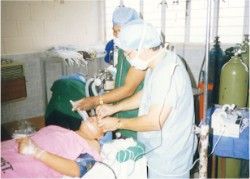
From there we were then taken directly to the clinic where I was permitted to observe an operation on a nineteen year old mother to remove a massive goiter from her neck. I watched as she walked into the operating room, kissed her husband, lay down on the operating table, and closed her eyes. I watched as the attending physicians tied her arms and legs to the operating table with strips taken from the leaf of a nearby palm tree. I watched as Dr. Dela Cruz carefully but quickly began the operation to remove two tumors which were encircling her windpipe. I was still there two hours later when the surgery was finished, and I was exhausted, but for Dr. Dela Cruz and the others, it was on to the next patient.
Before the mission ended four days later, over three hundred people had been treated for various conditions including surgeries for goiters, hernias, cataracts, cysts, and cleft pallet; treatment of skin diseases, respiratory diseases, and malnutrition. A total of over 30 doctors and Rotarians were involved in the mission. The sacrifice of the physicians and support people who planned and implemented the mission was staggering. One of the anesthesiologists brought his own cardiac monitoring equipment with him from the United States. Dr. Dela Cruz brought approximately $6,000 worth of surgical equipment and supplies with him for the operations. An additional $20,00 worth of medicines, and drugs which had been collected and brought to the clinic, were dispensed free of charge during the Mission.
Tuesday evening, December 7, while I spoke to a the Rotary club of Orani the medical mission continued through the night and into the following morning (3:00 am). The medical team was back at work at 8:00 a.m. the next morning, for another grueling 18 hour day. By the end of the week, everyone who had been scheduled for treatment, and many more unscheduled patients, had been treated.
While the mission continued at Orani, Georganna and I were taken to the old Subic Bay naval station, where we visited a school for the deaf and mute in a nearby village. The school was started and supported by personnel from the naval station up until the base was closed. It has since been adopted by several Rotary clubs in the area, and continues to serve the deaf children there. We sat in the class rooms and observed, and sometimes cried as the children struggled to produce sounds they could not hear, and we cheered and clapped for them when they succeeded. The children even gave us an impromptu demonstration of singing and dancing using sign language. The first song was the "Lord's Prayer", and there was not a dry eye in the crowd when they finished.
Just down the street from the school, we visited a Rotary Village Corp project sponsored by the Rotarians of Olongapo. This was a "Skills Development Training Center" for teaching sewing skills to people in that economically devastated area. Later, we spent a day with a Rotary Mobile X_Ray unit on it's monthly visit to a distressed neighborhood. Another day was spent handing out Christmas gifts to children at an Orphanage.


Download the website sponsorship guide